
English
Reading at Trinity
At Trinity, we believe that reading is an essential life skill that enables children to access a greater understanding of cultures and the wider world around them. Teaching reading to children creates a gateway to access other experiences throughout their life, in education and the wider world. At Trinity, we believe in allowing every child to have the best possibilities in and out of school and know that reading is at the heart of that. Our philosophy at the school is that all children will leave each stage of their education as confident and expressive readers who can confidently discuss different types of text and discover who they are as readers; what genres they enjoy and thus be able to recommend different books to their peers and teachers. We believe in equipping children with the necessary skills to recognise words at the earliest level, apply sight knowledge of reading and also then develop a wider vocabulary across many subjects in the school. We want to develop curiosity and cultivate inquisitive readers at the school. We want the children at our school to be able to champion the power that reading has to tell us about the world around us and to put their hearts into reading.

Class Scrap Books
Each week, pupils take it in turns to complete the class reading scrap book. They then have the opportunity to share their recommended read to the rest of the class.
Whole Class Reading
In whole class reading, we practise our fluency skills in each lesson and also engage in rich discussion about extracts from a range of genre.
Reading at Home
At Trinity, pupils take home two reading books each: one from our progressive Bug Club scheme and another of free choice from our class libraries. Pupils log their home reads on Boom Reader.
Reading Raffle
Everyone who reads at least five times a week earns a weekly raffle ticket and the potential to be drawn out in our half-termly Reading Raffle with exciting prizes!
Reading Lessons
At Trinity, each year group has at least four reading lessons a week, each lasting 30 minutes. The majority of each lesson is spent reading and discussing texts, with some opportunities for recording written responses. We use a range of high-quality texts from our Trinity Reading Spine and extracts linking to the wider curriuclum.
•Three 'structures' to address these areas
Reading lessons will have three structures:
- Fluency Read: An extract from the class text, linked or connected text, poetry
- Close Read: Language rich extracts. Can be from class text, poetry or a linked or connected text.
- Extended Read: Class text
Writing at Trinity
At Trinity, we believe in the importance of nurturing and cultivating ambitious and enthusiastic writers, who gain enjoyment from communicating their ideas, thoughts and creativity. We want to foster a love of writing across a range of genres by applying children with the tools they need to write with confidence and independence. We also want to engage our pupils in a knowledge-rich curriculum, which allows the writing to draw upon many other areas of learning. Children that show flair and confidence within writing will be given opportunities to show mastery of the subject. We want our writers to have a clear understanding of their audience and purpose for writing and be able to adapt language and writing concepts to fit with the genre they are studying, whilst drawing on a range of influences, experiences and stimuli. We want our children to become independent in their ability to edit and improve their work, whilst also taking pride in their presentation and their outcomes. As a school, we promote the importance of vocabulary in English and across different subjects. Our belief is that all children should feel valued as writers and communicators and therefore make sure all children have opportunities to share ideas across the school.
The Write Stuff
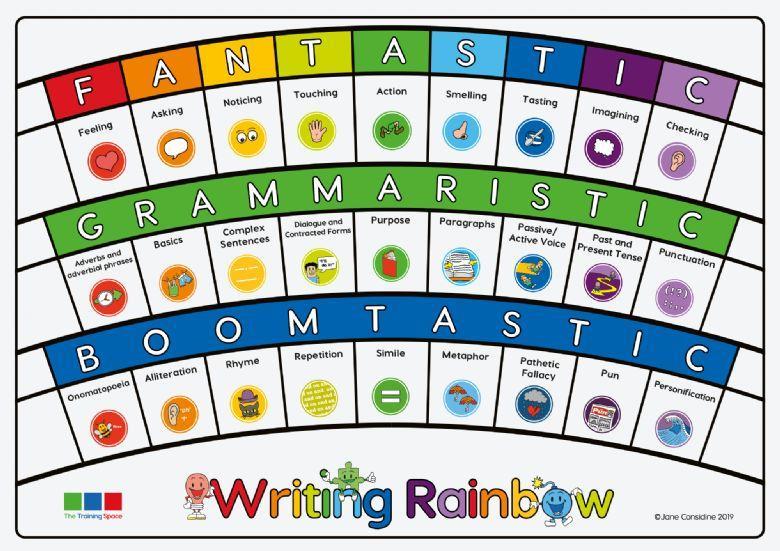
At Trinity, we follow The Write Stuff for our writing planning which focusses on oracy, vocabulary gathering and then sentence stacking with a focus on grammar linked to year group objectives. The 2025 Writing Framework states, "A growing consensus from research and practice in schools indicates that the best way to teach pupils to write is by teaching them to master sentences. All writing is ultimately made up of sentences: only once the concept of a sentence is understood will paragraphs and longer pieces of writing make sense, let alone convey meaning."
Writing lessons are broken down into three "chunks."
Review: children have the opportunity to retrieve a previously taught skill or correct a misconception identified by the teacher
Engage: a weekly focus grammar objective taken from the National Curriculum
Create: an opportunity to develop creativity and "think like an author"
Handwriting and Spelling
In addition to English lessons, Handwriting and Spelling are also taught precisely, in line with our progression documents. We use Nelson Handwriting and Spelling Shed (KS2) to support with this.